

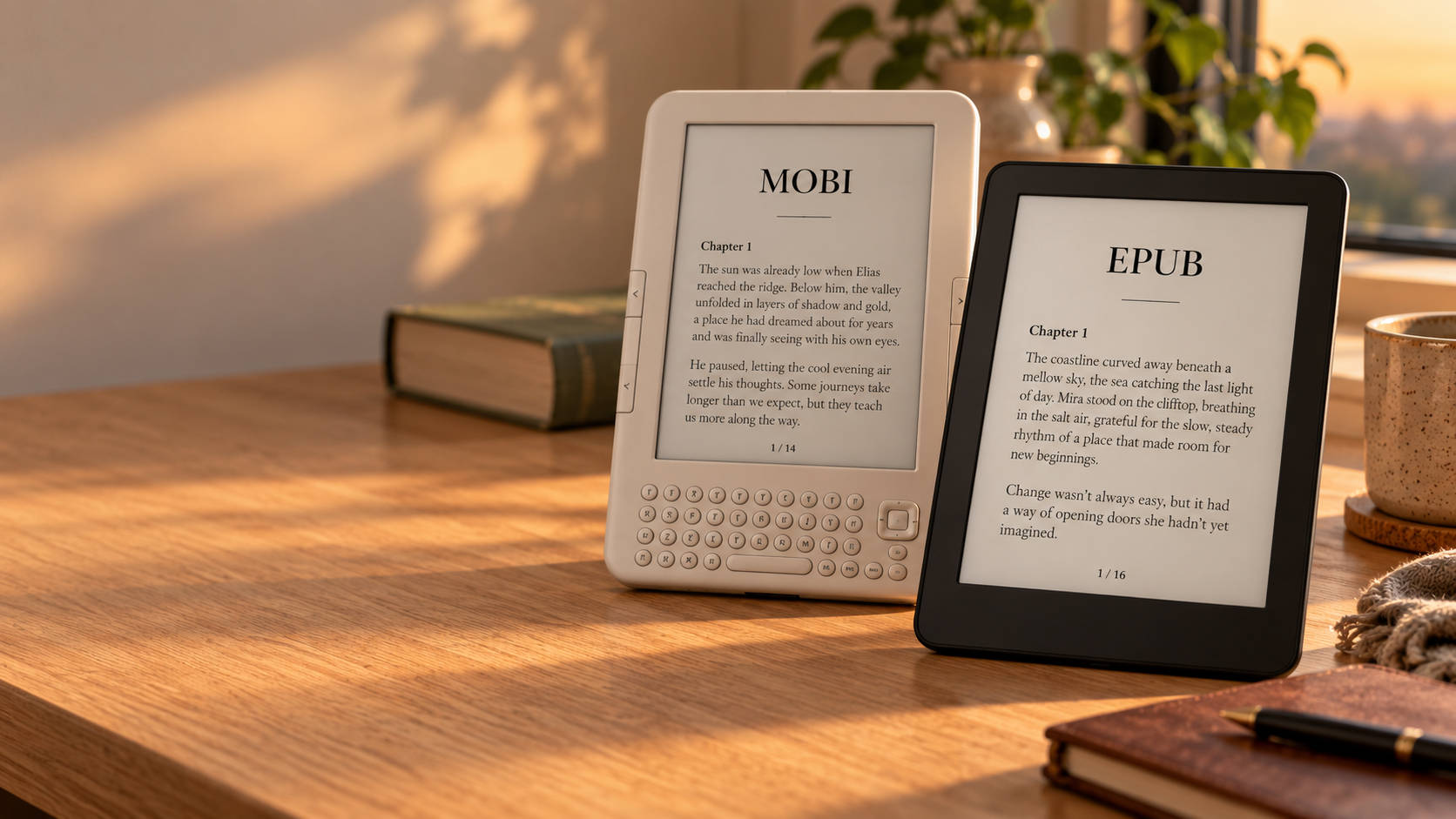
If you have collected ebooks for several years, you probably have a few files ending in .mobi. For a long time, MOBI was closely associated with Kindle, and downloading a book often meant choosing between an EPUB edition and a MOBI version.
Today, that choice is increasingly unnecessary. Amazon has moved away from accepting MOBI files, while newer formats and publishing workflows have taken its place.
So what happened to a format that once seemed essential?
Before Kindle, there was Mobipocket
MOBI originated with Mobipocket, a company that introduced its ebook format in 2000. It was designed for an era of personal digital assistants and early mobile devices, when screens were small and storage was limited.
Its important feature was reflowable text: paragraphs could rearrange themselves to fit different screens rather than remaining locked to a printed page.
Amazon acquired Mobipocket in 2005. When the first Kindle arrived in 2007, Mobipocket technology helped underpin Amazon’s ebook ecosystem. Amazon subsequently extended that technology into its own Kindle formats.
For readers, MOBI became a familiar way to move books onto a Kindle. For publishers, it became part of preparing ebooks for Amazon.
Why was MOBI phased out?
The main reason was technological progress. A format designed around early handheld devices became a legacy component in an increasingly sophisticated reading platform.
Amazon’s stated reasons for ending MOBI publishing support include simplifying ebook creation, reducing the work associated with producing MOBI files, and supporting its Enhanced Typesetting workflow.
There is also a practical publishing benefit. If a publisher already prepares an EPUB edition, accepting that file removes the need to produce a separate MOBI version for submission. Amazon can process the uploaded source and deliver a suitable Kindle file.
This distinction matters: the file a publisher uploads does not have to be the same format a reader receives.
The change happened in stages
MOBI did not disappear on a single date. Amazon’s publishing platform and its personal-document delivery service are separate systems, so changes to one should not be confused with changes to the other.
For Kindle Direct Publishing, the key dates are clear:
| Date | Change |
|---|---|
| 1 August 2021 | KDP stopped accepting MOBI files for reflowable ebooks. |
| 18 March 2025 | KDP stopped accepting MOBI files for fixed-layout ebooks, completing its transition away from MOBI submissions. |
Amazon now directs publishers towards alternatives such as EPUB, DOCX and KPF, depending on the publication. Previously published books do not need to be resubmitted simply because their original upload was a MOBI file.
For personal reading, Amazon’s current Send to Kindle file list includes EPUB but excludes MOBI.
Did EPUB replace MOBI on Kindle?
EPUB has taken over an important role as an input format, but that does not mean Kindle devices now open EPUB files directly in the same way as many other e-readers.
When you use Send to Kindle, Amazon processes the EPUB for its reading environment. Accepting EPUB for delivery is different from adding native support for an EPUB copied onto a device.
Within Kindle’s history, Amazon also developed its own successors to the original Mobipocket-based technology, including formats associated with AZW, AZW3 and KFX. The transition was therefore broader than simply swapping one filename extension for another.
Are old MOBI books now useless?
An old file does not stop working merely because a publishing platform no longer accepts new uploads in that format. Whether you can still read it depends on the software, device and any copy protection attached to the book.
For an existing collection, a sensible approach is to keep the original files and check compatibility before converting them. If a book is protected by digital rights management, ordinary format conversion may not be available.
Conversion also cannot recreate information missing from the original. A newer file extension alone will not improve poorly structured text or restore lost formatting.
MOBI’s place in ebook history
MOBI helped make digital books practical on portable screens and contributed to the foundations of Kindle. Its decline reflects how much ebook publishing has changed since those early devices.
For readers, the useful lesson is to distinguish between a format being retired from a service and a book becoming unreadable. For publishers, it is a reminder to maintain good source files and follow current submission requirements.
MOBI remains part of ebook history—and many personal libraries—even though its role in modern publishing has largely come to an end.




Leave a Reply