

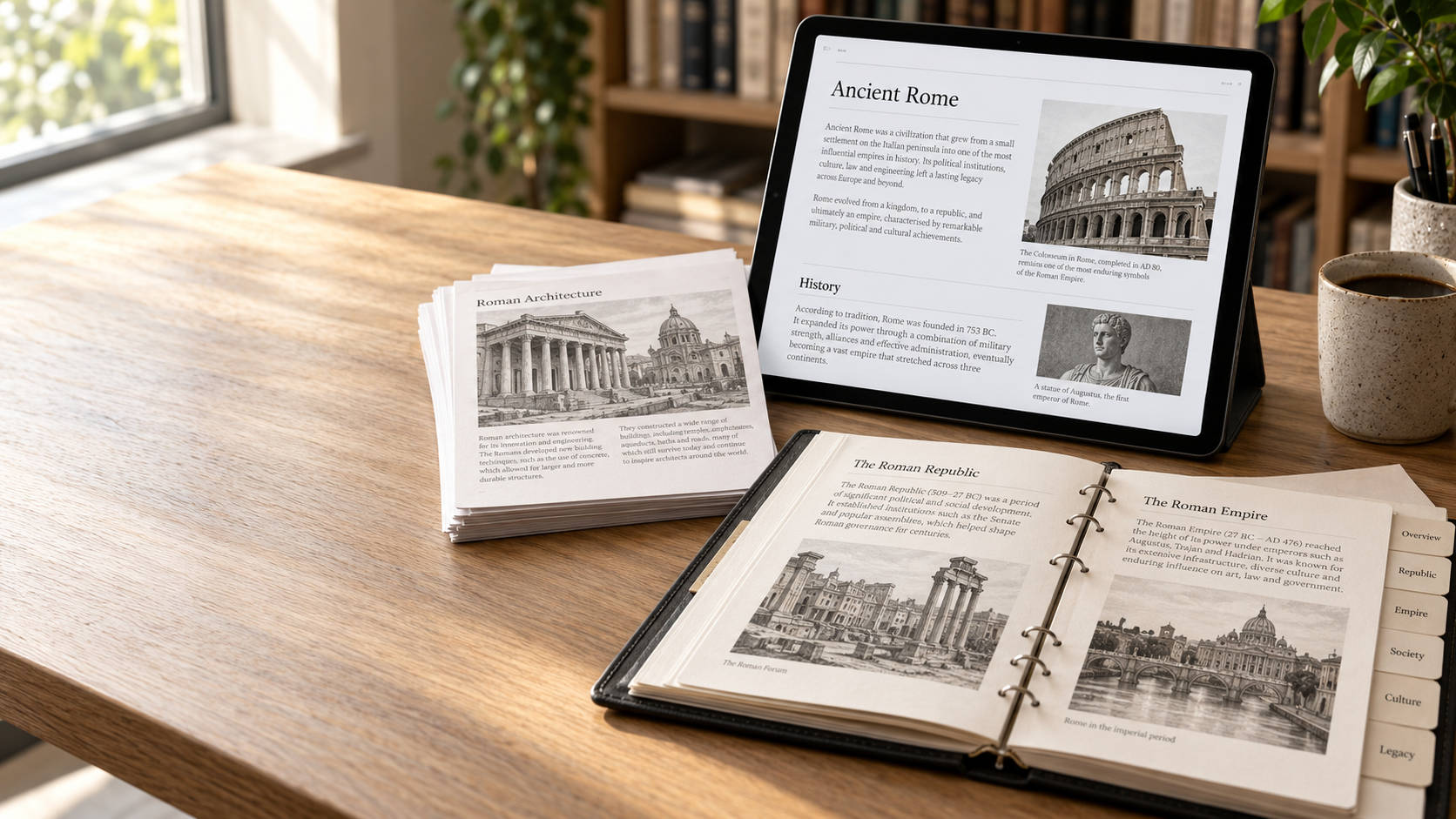
Imagine collecting Wikipedia articles about Ancient Rome, arranging them into chapters and turning them into a personal reference book. That was the idea behind Wikipedia’s Book Creator.
It offered an appealing way to turn browsing into organised reading. However, older tutorials can be misleading: the original workflow is no longer a reliable guide to what is available today.
What was Book Creator?
Book Creator allowed readers to collect Wikipedia articles and organise them into a book-like collection. Instead of following an endless trail of links, you could choose a subject, select relevant pages and decide their reading order.
The collection tools supported titles, subtitles and chapters. Readers could rearrange articles, remove unwanted pages and save collections for later use or sharing. Historically, the project also connected collections to downloadable documents and printed books.
A student could assemble a revision guide about the Solar System. A traveller could collect articles about a destination’s history and architecture. Someone interested in computing could create a reading list covering early computers, operating systems and the internet.
The result was a curated selection of encyclopedia entries, rather than a newly written textbook.
How did it work?
The historical process was straightforward:
- Activate the Book Creator.
- Browse Wikipedia and add articles to the collection.
- Open the collection manager.
- Give the book a title and arrange its contents.
- Use the available export or printing options.
The attraction was selection: readers could build a collection around their own interests instead of downloading unrelated material. Historical documentation describes this article-collection workflow, but it should not be treated as a current installation or usage guide.
What happened to it?
The feature lost important functionality over time. Wikipedia’s historical documentation records the withdrawal of its on-site book PDF service in 2017. On English Wikipedia, the dedicated Book namespace—the area used to store community book collections—was removed in 2021.
The underlying MediaWiki Collection extension still has documentation, but it is marked as not actively maintained. Its presence on another wiki does not mean that the original Wikipedia book-export service has returned.
This distinction matters when following an old tutorial. A “Create a book” link, a collection manager and a working downloadable book are separate things.
Can you still download Wikipedia articles?
Yes. Downloading a single article as a PDF is separate from exporting an entire collection. MediaWiki’s help documentation identifies “Download as PDF” as a single-article feature and states that downloading a whole collection as a PDF is no longer supported through that workflow.
For a short reading pack, a practical approach is to save individual articles and organise the files into a folder. If you combine them into a larger document, check the final layout: tables, references and images do not always behave neatly across page breaks.
An offline copy is also a snapshot. Later corrections to the online article will not automatically appear in your saved document.
What about larger offline collections?
For broader offline access, Kiwix offers a different approach. Its tools let readers access downloaded knowledge collections without an internet connection, including Wikipedia content.
Kiwix is an offline reading solution rather than a direct replacement for assembling a small, chapter-based ebook inside Wikipedia. It is particularly relevant when reliable internet access is unavailable.
Choose the approach according to your purpose: a few saved PDFs for focused reading, or an offline collection for wider exploration.
Is creating a book from Wikipedia allowed?
Wikipedia’s open licensing makes reuse possible, including redistribution, provided you follow the applicable terms.
Most Wikipedia text is available under Creative Commons Attribution-ShareAlike 4.0. When redistributing it, you generally need to credit its contributors, identify the source, include the licence information and indicate changes. Adapted text must follow the relevant ShareAlike requirements.
Images require separate attention. Their licences can differ from the article text, and material used under copyright exceptions is not automatically reusable elsewhere. Check each image’s description page before including it in a book you intend to distribute.
Open licensing provides permission with conditions; it does not mean the content has no copyright.
A useful idea beyond the original tool
Book Creator recognised that reading and browsing are different activities. Browsing encourages discovery; a carefully ordered collection encourages sustained attention.
That idea remains useful. Choose a clear topic, select articles thoughtfully, retain their references and record when you saved them. Read critically, and consult the cited sources when you need greater depth.
The original Wikipedia Book Creator may have faded, but its central idea still works: turn a collection of interesting pages into a deliberate path through a subject.

Leave a Reply